Attention is the scarcest resource in your company
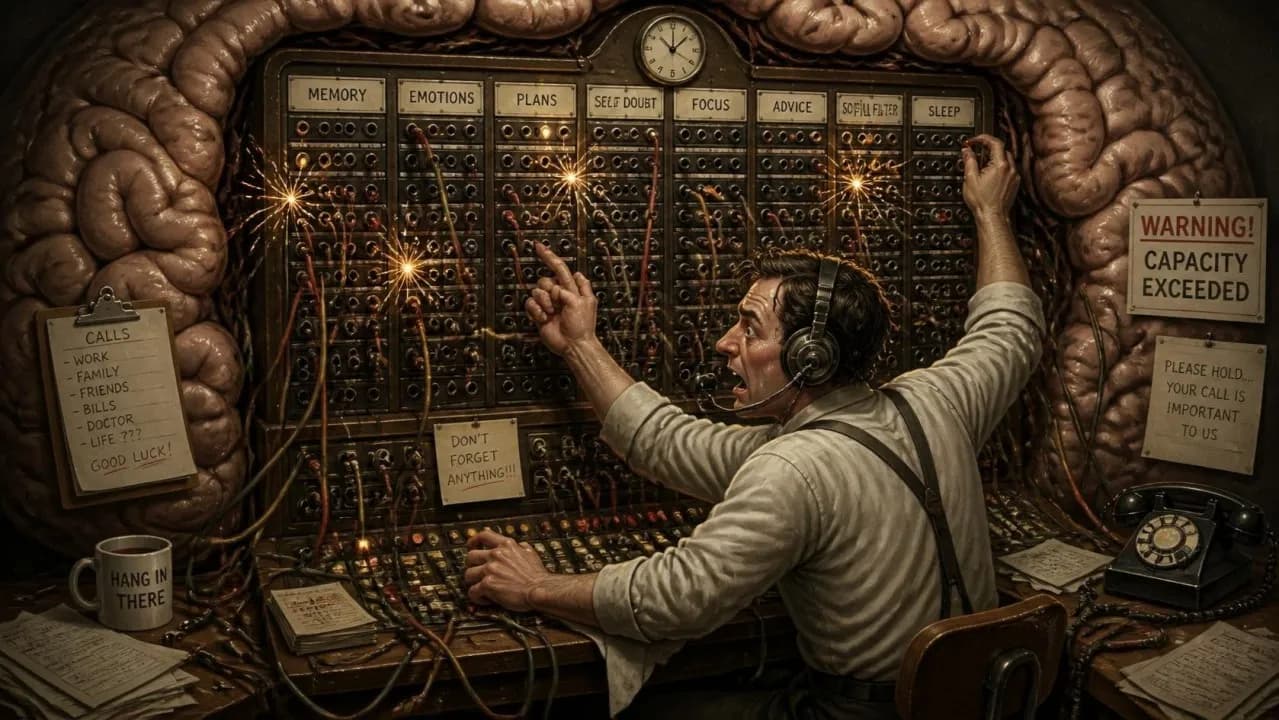
A new term has emerged in organizational and cognitive science research to describe what is happening in modern work environments: cognitive load capitalism.
The term, introduced by Dr. Nicholas J. Pirro at Pyrrhic Press, describes the structural and cultural forces that normalize mental exhaustion at work.[1] Unlike burnout that results from overwork or a toxic culture, cognitive load capitalism is subtler. It doesn't show up in the number of hours worked but in how the work itself is designed: fragmented workflows, overlapping tools, real-time surveillance, and bureaucratized collaboration.
While organizations digitize in order to become smarter, many are actually becoming organizationally dumber. They are losing institutional intelligence through mental fragmentation. The paradox is that the more they optimize for throughput, the more they suppress the cognitive capacity that makes meaningful output possible in the first place.
Three patterns that exhaust organizational intelligence
Research consistently identifies three structural patterns that create the greatest cognitive load in modern organizations.
Fragmentation of focus and task/content switching. The modern workday is filled with overlapping tools and constant context switching. Switching between tasks depletes working memory and impairs judgment - not because people are weak, but because the human brain simply isn't built to effectively handle multiple things at once.[1] Modern digital workflows demand dozens of such switches daily, especially between the strategic, operational, and interpersonal levels. Meeting overload. Many organizations reward visibility and presence over measurable impact. The result: executives with less than two hours of unscheduled time per week. Reflection, strategic synthesis, and mentoring are displaced by coordination tasks. Meetings create the appearance of work while consuming the conditions needed for real thinking. Digital Taylorism. Instead of measuring cognitive contribution, many systems track activity metrics: time spent online, number of clicks, response speed, and meeting attendance.[1] This is a direct descendant of Taylor's time-and-motion studies, applied to intellectual work. It measures the wrong thing, and in doing so, optimizes for the wrong thing. The challenge is not to reduce stress or the number of hours worked. The challenge is to shape a work environment that respects the limits of human cognition while simultaneously unlocking its strengths.
What organizations must change
Research clearly shows what is needed in practice for cognitive sustainability.
Deep work (focus) zones - establishing clear rules about meeting-free time. For example, blocks of 2 to 4 hours of uninterrupted work allow people to focus and solve complex problems. This becomes an operational prerequisite for roles that involve synthesis, design, or strategic judgment. Tool management - through the rationalization of digital tools, instead of introducing new applications, we reduce the cognitive cost of constant attention switching. Every new tool should be evaluated for the cognitive load it adds before it is introduced. Managing cognitive load at the team level because clearly defining processes and decision-making rules relieves the individual, and documenting processes frees working memory from having to unnecessarily remember routine steps. The cognitive cost of unclear ownership or undocumented decisions is paid every time someone new faces the same situation without clear guidance. Focus should be placed on outcomes rather than activity. Measuring success based on real results and strategic goals removes the dynamic of digital Taylorism that creates cognitive burden without value.
The organizational dimension: where CogniPulse comes in
What cognitive science describes at the individual level, organizational diagnostics can measure at the system level. Cognitive overload is not randomly distributed across an organization. It concentrates in specific patterns, and those patterns are visible, measurable, and solvable. The question is not just whether people feel overloaded, but why the burden sits exactly where it does, which structural patterns create it, and which behaviors amplify or absorb it. Two patterns from the Pyrrhic Press research are especially relevant as an entry point for diagnosis.
Unclear ownership of decisions creates repeated cognitive effort. When it isn't clear who can decide what, every decision requires a search for authority before it can even be made. That search consumes working memory, delays execution, and creates exactly the kind of meeting proliferation that blocks deep work. This is not an attention problem at the individual level. This is a structural design problem at the organizational level. The decay of institutional memory amplifies cognitive load over time. When knowledge is not recorded, every new person or situation requires rebuilding context from scratch. Experienced employees carry enormous cognitive loads because the organization has not created the structure that would allow them to work efficiently.
COGNIPULSE BEHAVIORAL EX
Behavioral EX measures the operational patterns that create or reduce cognitive load at the team and organizational level. Not through a well-being survey, but through behavioral observation: how decisions that affect people's daily work are made and communicated; where managerial bottlenecks create friction before it ever reaches a survey; and where a mismatch between role and capability creates a specific kind of constant background effort that precedes an employee's departure.
While traditional employee experience tools measure how people feel about their workload, Behavioral EX identifies the specific structural patterns that create that feeling. These are unclear ownership, communication problems, manager overload, and escalation patterns.
From individual exhaustion to organizational design
The most important shift in this research is the change in how cognitive overload is perceived - from an individual problem to a problem of organizational design.
Traditional wellness programs fail precisely because they treat burnout as a behavioral deficit, rather than as a flaw in system design.[1] You cannot log out of a broken decision architecture. You cannot meditate your way around unclear ownership. Resilience training does not solve tool proliferation. The organizations that will gain an advantage on this dimension are not the ones investing the most in employee wellness benefits. They are the ones redesigning the structural conditions that create unnecessary cognitive cost - and measuring whether those conditions are improving.
In an era where attention is the scarcest resource, an organization's intelligence is no longer just a function of its data systems. It is a function of its ability to protect and empower the cognitive resources of its people.
SOURCES
[1] Dr. Nicholas J. Pirro, Cognitive Load Capitalism: How Modern Work Design Exhausts Executive Function and Undermines Organizational Intelligence, Pyrrhic Press, 2025
[2] IT Revolution, Team Cognitive Load: The Hidden Crisis in Modern Tech Organizations
[3] Rubinstein, Meyer & Evans, Executive control of cognitive processes in task switching, Journal of Experimental Psychology, 2001