Beyond the org chart: what classic 360 feedback can't see
Organizations have used 360 feedback for decades as a tool for leadership development. The logic is familiar: gather input from a manager, peers, and direct reports; compile a report; hold a development conversation. The tool is useful and well-documented, and research shows that the quality of behavioral statements directly determines how effective such a report turns out to be.[1]
However, classic 360 has two structural weaknesses that have become more serious over time.
The first is that it is most often reserved for managers. The second is that it measures general competencies and a general impression, like "is a good communicator" or "is collaborative," but without precise insight into which behavior creates that impression and where exactly the problem arises when the impression isn't good.
In today's modern organizations, both weaknesses are becoming costly. In the future, they will become even more "costly."
Why 360 is most often tied to managers
First, 360 feedback originated within the discipline of executive coaching and leadership development. The methodology (multi-rater assessment, anonymity, and a development conversation following the report) was designed to solve a specific problem - managers rarely receive honest feedback because the people below them in the hierarchy have a motive to stay silent. The tool remained in that niche for decades.[2]
Second, we can add the economic aspect to that, because 360 feedback is a relatively expensive process. It requires time from multiple raters, administration, a report, and a development conversation. Organizations naturally direct that kind of resource where they expect the greatest return, and the traditional assumption is that a manager's decisions affect more people than the decisions of an individual contributor.
Third, most commercial 360 tools are built around leadership competency frameworks, e.g., strategic thinking, leading change, and decision-making under uncertainty.[3] Those competencies make sense for someone who formally leads people. Applying the same framework to a senior engineer or an internal stakeholder without direct reports produces results that don't match their actual role.
Influence no longer follows the hierarchy
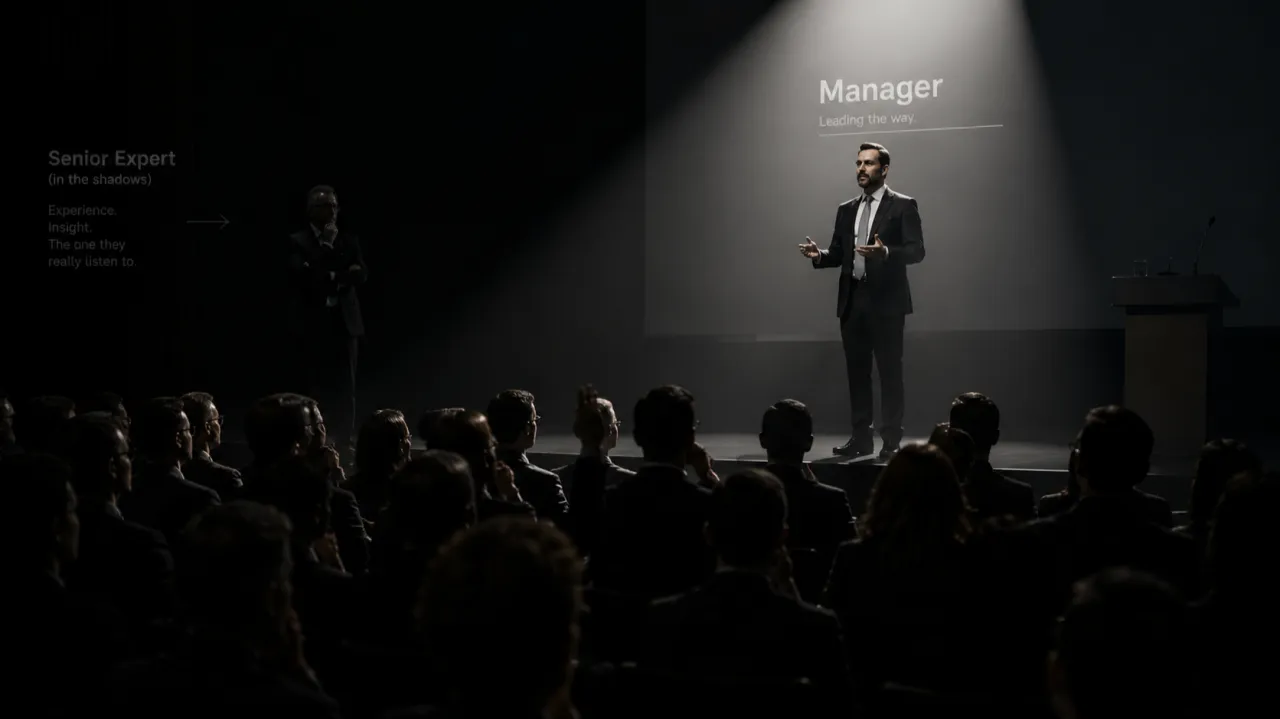
The assumption behind classic 360 feedback is simple: the people with the greatest influence on others' work are those with a formal manager title, so they should be assessed from multiple angles. That assumption was true in organizations built on strict hierarchy. In modern, matrix, and scale-up organizations, it is no longer the rule.
For example, a senior expert without a single direct report can, through their behavior, slow down or speed up the work of an entire team - through how they share knowledge, how they respond to differing opinions, and how available they are when someone gets stuck. A project manager without formal authority over the people they coordinate has daily influence on dozens of decisions. An internal stakeholder who is late with feedback can block an entire project - and in a classic 360 system, that person may not even be assessed at all.
When an organization doesn't understand the behavioral patterns of its people, problems start being explained too generally: "communication," "culture," "mindset," "leadership," and "engagement." Those explanations are rarely precise enough to act on.
From impression to behavior that can be seen and changed
The second weakness of classic 360 is subtler, but just as significant: it measures impression, not behavior. When a rater in a classic questionnaire rates someone's "communication" a 3 out of 5, the organization gets a number, but it doesn't get information about what exactly needs to change. Is the problem that the person doesn't share information on time? Why don't they check whether agreements were clearly understood? Why don't they distinguish important from secondary in communication? Each of these possibilities requires a different intervention, and the general impression reveals neither what nor how to intervene.
Expert literature on 360 instrument design recognizes this as a core quality principle: behavioral statements should describe specific, visible actions that reflect a competency, not what someone assumes a person thinks or intends.[1] When a question measures visible behavior instead of a general trait, the result is clearer, more reliable, and easier to act on.
The Behavioral 360 approach applies that logic consistently. Instead of asking, "What kind of colleague is someone?" it poses concrete, observable statements: Do they follow through on agreements? Do they inform others on time when they're running late? Do they ask for support when something is missing? Do they check whether key agreements were clearly understood? Each statement describes behavior that someone could actually have recognized.
The behaviors that slow decisions down
The biggest structural difference lies in one category that classic 360 tools don't contain at all: behaviors that create or reduce friction in collaboration and decision-making. Every organization has people whose behavior slows down decisions. A person who doesn't escalate in time when something is missing. A person who avoids making a decision within their own authority and waits for someone else to make it instead. A person who doesn't communicate early enough when they know a deadline won't be met. Each of these patterns individually might look minor, but added up across the entire organization, it's a cost felt in every delay, every escalation, every project that takes longer than it should.
Classic 360 feedback doesn't recognize this dimension because it isn't designed to "look for" it. It measures competencies like leadership and communication, but it doesn't measure the specific extent to which this person's behavior contributes to decisions running late or collaboration getting stuck (repeated rework, unclear handoffs, decisions that don't stick...).
Modularity that follows the actual role, not the position within the hierarchy
Behavioral 360 doesn't treat all employees as one type of role. Everyone goes through the same Core module (nine areas that apply to everyone, from reliability and follow-through to self-reflection and developmental maturity). Roles that carry an additional type of influence get additional modules without changing the core for everyone else.
Formal managers get a leadership module that measures setting priorities, delegating, and team-level decision-making. Project and cross-functional roles get a Cross-functional module that measures how work moves across teams without formal authority. Senior experts with strong informal influence get a senior expert module that measures how their influence shapes reasoning and standards within the team. This architecture means everyone gets a report relevant to the actual individual role they "play" in the organization.
From an annual snapshot to a continuous behavioral picture
A classic 360 is usually conducted once a year. One snapshot of the current state, followed by a development conversation and then a long pause until the next cycle. Experts in the 360 feedback field themselves point out that insight without structured support rarely produces lasting behavior change, because feedback needs continuous reinforcement, not a one-time report.[4]
Behavioral 360 is a shift toward a system that changes the nature of the insight an organization gets. Instead of one annual leadership assessment, the organization gets a continuous behavioral picture of everyone whose behavior actually shapes how work gets done.
The gap between self-perception and how others see you becomes visible
Behavioral 360 structurally includes self-assessment as an equal perspective. That comparison produces the Self-Other Gap: a measure of how much a person's own perception of their behavior differs from how others experience it. A large gap is in itself a clear signal that there's a developmental blind spot worth addressing before it becomes a bigger problem. The ability to accurately perceive one's own behavior is not a side detail here, but the foundation on which any development intervention that has a chance of working actually stands.[1]
Why this difference matters more now than before
Organizations that are growing face a specific problem: the formal structure explains less and less of people's actual influence. The org chart shows who reports to whom. It doesn't show who actually slows down decisions, who creates coordination chaos, or who holds a team together through their behavior despite having no formal title for it.
Classic 360 feedback, built for a hierarchical world and focused on general competencies, can't see that layer. Behavioral 360 is built exactly for that, because it's designed to measure behavior and includes a specific category for friction in collaboration and decision-making that otherwise remains invisible until its effects accumulate into lost time and frustration.
The difference Behavioral 360 brings is significant - whether we recognize an organizational problem while it's still small or only once it's grown large enough to be felt across all results.
SOURCES
[1] Envisia Learning, How to Write Clear Behavioral Statements for 360 Feedback
[2] Envisia Learning, 360 Degree Feedback for Leadership Development
[3] Envisia Learning, Leadership Assessment Tool — Leader View 360
[4] Envisia Learning, How to Leverage 360 Degree Feedback for Successful Behaviour Change
[5] CogniPulse, Behavioral 360 Review