Employee experience is a revenue line, but most organizations are still measuring it like a perk.
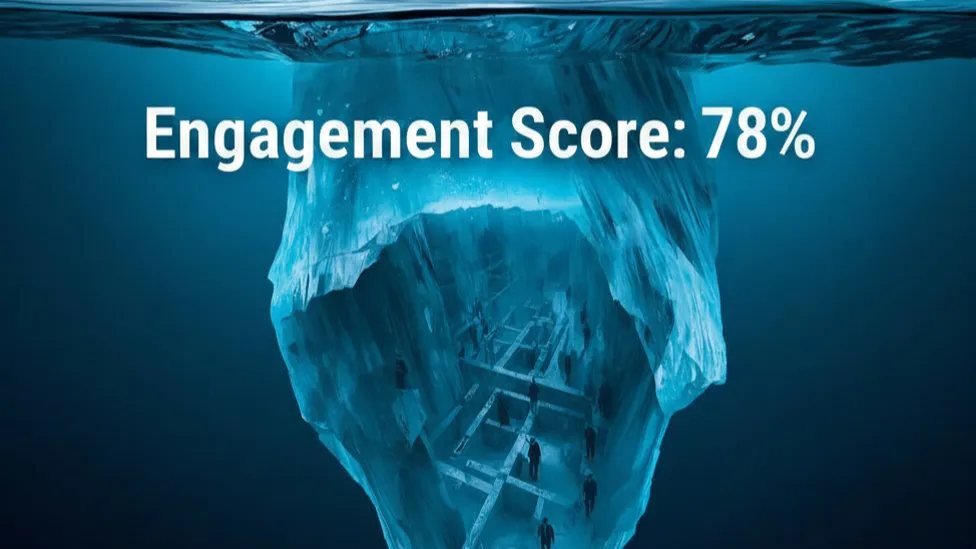
The illusion
Engagement surveys tell you how people feel. They rarely tell you why or what that feeling is doing to your pipeline, your delivery, and your retention costs. That gap is where employee experience stops being an HR topic and becomes a board-level one.
“To win in the marketplace, you must first win in the workplace.” For years that line lived on motivational posters. It wasn't strategy; it was sentiment.[1]
That perspective is changing, and not because leaders suddenly care more about people, but because the financial trail has become impossible to ignore. Highly engaged teams achieve 23% greater profitability.[1] The inverse is just as real: when experience degrades, the damage shows up in client retention, product timelines, and the speed at which institutional and tacit knowledge walks out the door. And yet, EX is still measured the way it was a decade ago: an annual survey, an eNPS score, a slide in the all-hands deck. The metric hasn't kept pace with what it's supposed to explain.
23% greater profitability in teams with high engagement (Gallup)
70% estimated cost of replacing a departing senior employee, including ramp-up and knowledge loss (CIO, 2026)
29% of employees believe HR understands what they actually need (Gartner)
Experience and engagement are not the same thing
Employee experience is the lived reality of working somewhere: every interaction, system, and unspoken norm an employee encounters from first contact to exit.[2] Engagement was the organization's attempt to interpret that reality, at least to measure it. But without real action plans to respond to it. If experience is the foundation of a building, engagement is the floors built on top of it. [2] Renovate the floors all you want, but if the foundation has a crack, every floor inherits the problem. This is where most EX programs go wrong. They invest heavily in engagement surveys, recognition platforms, and well-being perks. All the while, the foundation underneath stays unmeasured: manager quality, decision clarity, and day-to-day challenges.[3]
Gallup is direct on this: manager quality is often the single biggest factor in whether employees have a positive or negative experience. Not perks. Not culture statements. The manager.
When the numbers look healthy but something is off
A CIO contributor described his own organization: revenue targets met, projections on track…yet something felt wrong.[1] The warning signs were hiding in plain sight: senior engineers leaving without clear reasons, teams once driven by ownership showing fatigue, and cross-team communication quietly weakening.[1] When the financial reality was examined, replacing each departing senior employee cost roughly 70% of their salary in recruitment, onboarding, ramp-up, and knowledge loss.[1] A significant share of the annual hiring budget went to backfilling within nine months. The hidden costs were worse. A departing customer success lead left gaps in follow-ups and overscheduled client calls. End result: the account wasn't renewed. A product release slipped two quarters because the people who understood the original architecture had already left.[1]
None of this showed up in an engagement score. It showed up in lost accounts, delayed launches, and a hiring budget consumed by replacement instead of growth.
This is the core problem with experience metrics as practiced today: they measure sentiment, but the consequences of poor experience land as operational and financial outcomes - in dashboards owned by entirely different teams, who rarely trace the cause back to experience.
Behavior is the missing link
Workplace behavior (how people communicate, respond under pressure, treat colleagues and customers…) is shaped by experience and, in turn, shapes performance.[6] Good behavior improves morale and retention. Poor behavior implies rudeness, bullying, and micromanagement that measurably degrades output, even with capable people involved. The factors are concrete: how duties are assigned relative to capability; how communication flows during decisions affecting people's work; and what the culture actually rewards versus what it claims to.[6] This is the layer most EX measurements miss. A survey can tell you morale dropped. It can't tell you whether that's an overloaded manager, an unclear escalation path, a communication breakdown between departments, or a role-capability mismatch. Without that distinction, every intervention is a guess.
Why EX resists quantification and why that's no longer acceptable
IBM's research is candid: employee experiences are hard to quantify, and organizations are difficult to change.[4] That has historically justified treating EX as a soft domain - although it is important, it is not something you could put a number on the way you'd quantify a pipeline or a production line. That justification no longer holds. Manager quality, decision clarity, communication patterns, role-capability fit - all observable, behavioral, measurable. The reason they haven't been measured isn't that they can't be; it's that the tools built for this space measure sentiment, not mechanism. Only 29% of employees believe HR understands what they actually need.[5] That number hasn't moved through years of EX investment because the investment went into asking people how they feel more often, with better dashboards, and not into understanding why the answer is what it is.
Asking how someone feels and understanding why they feel that way are two different disciplines. Most organizations have only built the first one.
From sentiment to mechanism
This is the gap CogniPulse Behavioral EX is built to close. Where traditional EX tools measure how people feel, such as satisfaction, engagement, and sentiment over time - Behavioral EX measures the behavioral and structural patterns that produce those feelings.
COGNIPULSE BEHAVIORAL EX
Behavioral EX analyses the operational reality behind employee experience: how decisions affecting people's daily work are made and communicated, where managerial bottlenecks create friction before it ever reaches a survey, and where role-capability mismatches generate the quiet fatigue that precedes attrition. Instead of an annual sentiment snapshot, it identifies the specific patterns like communication breakdowns, unclear ownership, role-capability gaps, manager overload – that are the root causes of the engagement and retention numbers leadership already tracks. The output isn't another satisfaction score. It's a map of where experience breaks down operationally and why.
For leadership, this reframes employee experience from a perception to manage into a mechanism to diagnose with the same rigor applied to any other driver of revenue, retention, and delivery.
From perception to prediction
Employee experience has earned its place as a revenue conversation. Engagement correlates with profitability, attrition has a calculable cost, and the gap between what HR measures and what employees need remains stubbornly wide.[1,5] Closing that gap requires more than better surveys. It requires understanding the behavioral and structural mechanisms such as manager quality, decision clarity, communication, and role fit – that finally produce the experience employees report.
Organizations that measure only sentiment will keep being surprised by attrition, delays, and accounts that 'came out of nowhere.' Organizations that measure the mechanism underneath will see those problems coming and act before the cost becomes irreversible.
SOURCES
[1] CIO, Why employee experience is now a revenue driver
[2] Personio, Why Has Employee Experience Become So Important?
[3] Gallup, Employee Experience: Strategies for Improvement
[4] IBM, What is Employee Experience?
[5] Gartner, Employee Experience
[6] WebHR, How does Behavior Drive Performance in the Workplace?