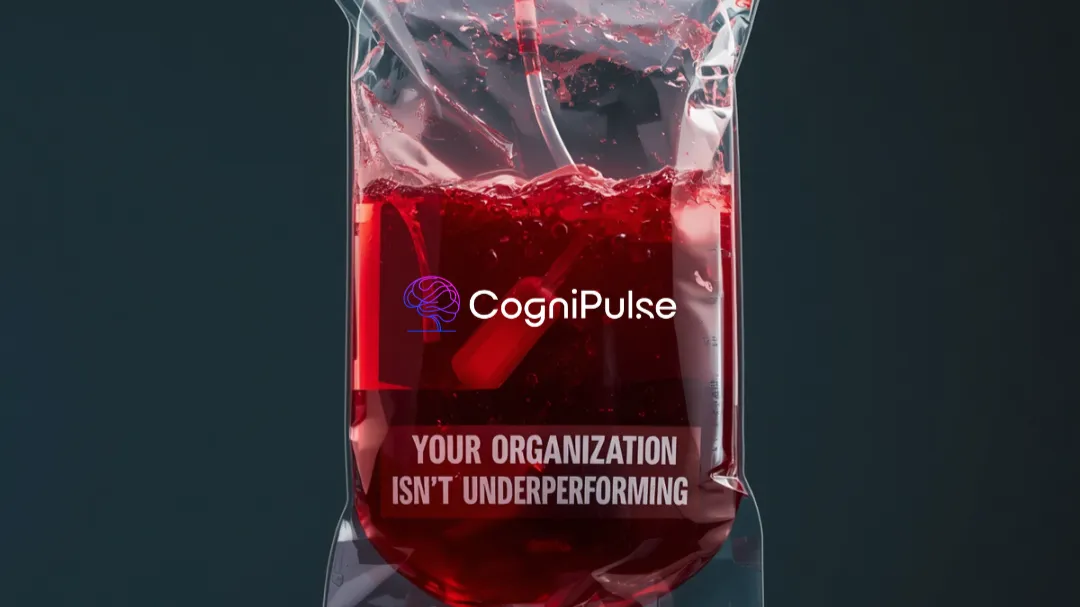
Your organization isn't underperforming; it's bleeding.
Uncertainty isn't a problem you solve with motivational workshops. Recent years have shown something many executives are still struggling to comprehend: geopolitical instability, inflationary pressure, supply chain disruptions, AI reshaping entire job categories and business models, and markets behaving irrationally. Fragility is no longer the exception; it has become an operational reality. In this environment, organizations that were already losing value through poor ways of working are now losing it faster.
What uncertainty does to employees
When the external context is unstable, employees don't become passive; they become cautious.
In organizational terms, caution means less initiative, because initiative carries risk. It means slower decisions, because mistakes in an uncertain environment cost more. It means filtering information upward, because bad news in a crisis period carries negative connotations.
The result is an organization that appears to function but slowly fragments from within.
Meetings multiply, output shrinks. Decisions escalate to the top or get reworked, because no one below wants to take ownership. The CEO becomes the bottleneck, not because they want to control everything, but because the system doesn't function without that validation.
Macroeconomic uncertainty as a catalyst, not the root cause
Uncertainty doesn't create organizational problems. It amplifies existing ones. A company that could "survive" poor decision-making or unclear accountability in a stable market can no longer do so in an unstable one. Because in an unstable environment, the cost of a delayed decision goes up. McKinsey research shows that executives spend close to 40% of their working time on decisions, while a large share of that time is considered poorly used. In a large organization, ineffective decision-making can translate into hundreds of thousands of lost management days and substantial labor costs. The business implication is clear: slow and unclear decision-making is not an abstract leadership issue but a measurable productivity loss.
How this shows up in the financials
Lost capacity that never gets recorded - coordination costs, meetings without output, duplicated work, and rework don't appear anywhere in the P&L. Slower time-to-decision when speed has a price - disruption demands fast adaptation. An organization with centralized decision-making and blurred accountability cannot respond quickly, even when everyone wants to. That lag has a direct cost: missed opportunities, late entry into new segments, reactivity instead of proactivity. Losing key people at the worst possible moment - the people who first recognize dysfunction are usually the most capable. In uncertain environments, they are often the first to disengage, not always by leaving, but by entering an internal "safe mode" of minimal contribution.
What executives typically do, and why it doesn't work
When external pressure becomes visible, the typical response is cost-cutting, restructuring, or accelerated investment in technology. But all of these are interventions on consequences. The damage is already done. Cutting costs without understanding where losses originate only moves the real problem elsewhere. Restructuring without changing how work gets done only changes the org chart, not the functioning. New tools in an organization that makes poor decisions accelerate poor decisions.
The equation of this era: poor judgment + AI = faster mistakes.
The real problem often isn't external
Organizations rarely lose value only because of external shocks. They lose it because, at the moment of the shock, they often have no visibility into how much capacity, speed, and decision quality they are already losing from within. So they don't know where to intervene. That is a measurement problem. Not a motivational one, not a cultural one, not a technological one.
Solutions exist. This is where CogniPulse comes in. CogniPulse does not start with motivation, satisfaction, or generic culture diagnostics. It starts with how work actually moves through the organization: where decisions slow down, where ownership becomes unclear, where work is repeated, where capacity is absorbed by coordination, and where leadership becomes the point through which too much of the organization must pass. The goal is not to describe organizational mood but to identify the mechanisms through which value is lost.