Where work actually flows, and where it depends on too few people.
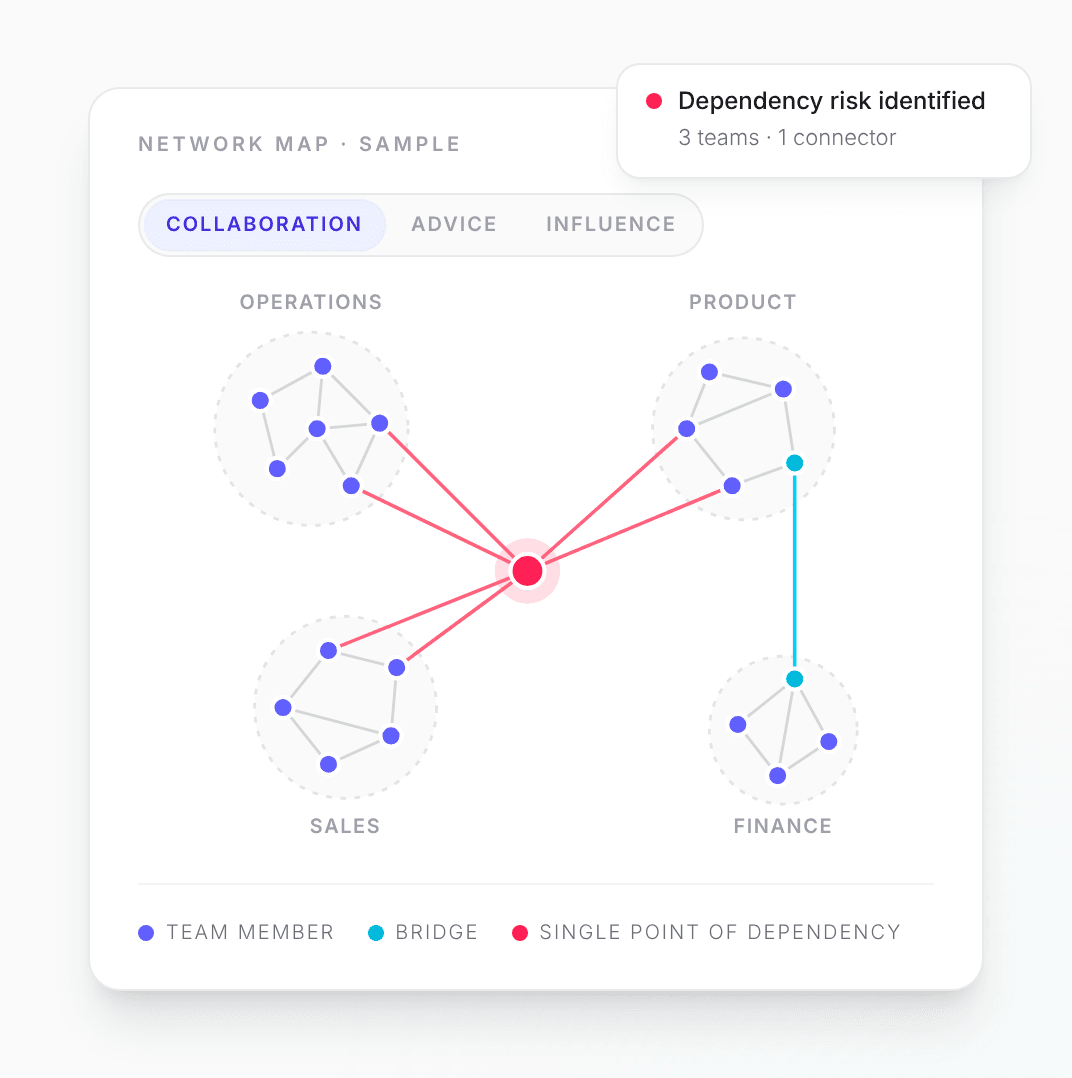
Your org chart shows who reports to whom. It doesn't show how work actually gets done. Organizational Network Analysis maps the real networks behind your organization: where information concentrates, who people turn to when something needs solving, who connects teams that otherwise don't work together, and where too much depends on too few.
Organizations don't lose value because of their people, they lose it because of how they work and make decisions.
As an organization grows, its formal structure and the way work really gets done drift apart. Teams route questions around the hierarchy, a few experienced people become the default answer to everything, and decisions wait on people who have no formal role in them. None of this shows up in the org chart or in conventional HR indicators. It becomes visible only when one of those people goes on leave, changes role or leaves, and work suddenly slows down.
3–5%
Of employees account for 20–35% of value-added collaborations
~80%
Of work time spent in meetings, calls and email at many companies
79%
Of employees isolated from informal networks left within a short period
Sources: Cross, Rebele & Grant, "Collaborative Overload", Harvard Business Review, 2016; Innovisor, client engagement in a pharmaceutical company, 2023.
Organizational Network Analysis introduces a different way of seeing the organization. Instead of asking how people feel about collaboration, it maps who actually works with whom, who people go to for advice, and who shapes decisions regardless of title.
The analysis shows the organization as a network of real dependencies: the people and teams that hold the information flow together, the bridges between functions, the informal experts, and the places where it is unclear who turns decisions into execution.
For leadership, this is a question of operational continuity, speed of collaboration and concentrated organizational risk. If a handful of people carry a disproportionate share of the information flow, their absence or departure becomes a business problem. Organizational Network Analysis doesn't replace organizational design and doesn't produce a new org chart. It shows where to look first.
Three networks that are invisible on paper
Formal structure stops at reporting lines. Organizational Network Analysis measures the relationships that determine whether work actually moves.
Collaboration
The daily working relationships that keep work moving across teams and functions.
Advice
Who people turn to when they are stuck, and where informal expertise sits.
Influence
Who shapes decisions, regardless of title.
From survey to decision-ready insight in two weeks
One short questionnaire. Three networks mapped from the answers. A report designed for the people who will act on it.
Launch
Employees receive a short questionnaire about who they work with, who they turn to for advice and who shapes decisions.
Collect
About 7 minutes per respondent.
Analyze
Responses are mapped into the collaboration, advice and influence networks to show where work concentrates and where dependencies form.
Deliver
Network map, dependency risk, formal vs. actual structure and priorities for action.
A clear picture of how work really flows and where your organization depends on too few people
Network map
How work actually flows across teams, functions and leadership layers.
Key-person and dependency risk
Where operational continuity rests on too few people or connections.
Formal vs. actual structure
Where the real flow of work and decisions differs from the org chart.
Priorities for action
Where to reduce dependency, strengthen connections or clarify responsibility.
Structural risk, not a list of names. How individual data is shown is defined upfront, based on the purpose of the analysis, privacy protection and applicable rules. Leadership reporting focuses on structural dependencies and organizational risk, not on a ranking of "important people".
Three situations where Organizational Network Analysis makes the difference
A few people seem to hold everything together.
Work slows down whenever certain people are away. Questions, approvals and know-how keep running through the same names, and you are not sure what would happen if one of them left.
The org chart and reality have drifted apart.
After growth, a reorganization or new leadership, the formal structure no longer describes how work gets done. You want to see the real picture before you change anything.
You are planning a restructuring or an integration.
Before you redraw the structure or merge teams, you want to know which connections hold the organization together, so you don't break them by accident.
When Organizational Network Analysis reveals that business-critical knowledge rests on a few people, the next question is succession readiness and continuity of key roles. That is where the **Organizational Readiness & Succession Decision System** takes over.
See how work actually flows in your organization.
A 30-minute walkthrough using anonymized data from a similar-size organization. No commitment, no pre-work.
Book a demo