How late does leadership find out that something is wrong?
Most bad news in an organization is not a secret. Someone knew the project was running late, that the client was unhappy, or that a decision rested on the wrong assumptions. Trust & Psychological Safety Index shows whether that information reaches leadership while there is still time to act, or only once it has become a cost.
Organizations don't lose value because of their people, they lose it because of how they work and make decisions.
Between the moment someone notices a problem and the moment leadership learns about it, weeks often pass. During that time the problem grows and the chance for an inexpensive correction disappears. The cause is rarely bad intent. People weigh whether it is worth saying something uncomfortable. If the messenger gets punished, a question is read as disagreement, or a problem is "not my responsibility", information gets filtered at every level. Each filter is small. Together they change the picture leadership sees.
26%
Of leaders create psychological safety for their teams
#1
Psychological safety was the most important of five factors behind effective teams, in a study of 180 teams
2×
Executives rated members of teams with a stronger team culture as effective twice as often
Sources: McKinsey, "Just 26 percent of leaders create psychological safety for their teams", 2021; Google, Project Aristotle, re:Work.
Trust & Psychological Safety Index treats trust and psychological safety not as goals in themselves, but as conditions that decide how fast critical information moves: whether people flag a mistake, challenge a weak decision, report a problem, or say early that something will not be delivered on time.
The index assesses whether the organizational context allows problems to surface early and information to be exchanged honestly, before a problem turns into a financial, operational or reputational cost.
Four conditions for information to reach leadership in time
Trust and psychological safety matter here for one reason: they decide whether information moves.
Speaking up
Whether people raise errors and risks when they see them.
Challenging decisions
Whether weak decisions get questioned before they are executed.
Early warning
Whether delays and problems reach leadership while there is still time to act.
Trust
Trust within the organization, both vertically, toward managers and leadership, and horizontally, between colleagues and teams.
From survey to report the moment collection closes
One short questionnaire. Results interpreted where they matter most: at team level.
Launch
Employees receive a short anonymous questionnaire on the four dimensions.
Collect
Responses are collected anonymously.
Report
The automated PDF report is available for download as soon as collection closes.
Measured anonymously and interpreted primarily at team level. An organization-wide view is shown only where aggregating the data is methodologically sound.
A clear picture of where information flows and where it stops
Team profile
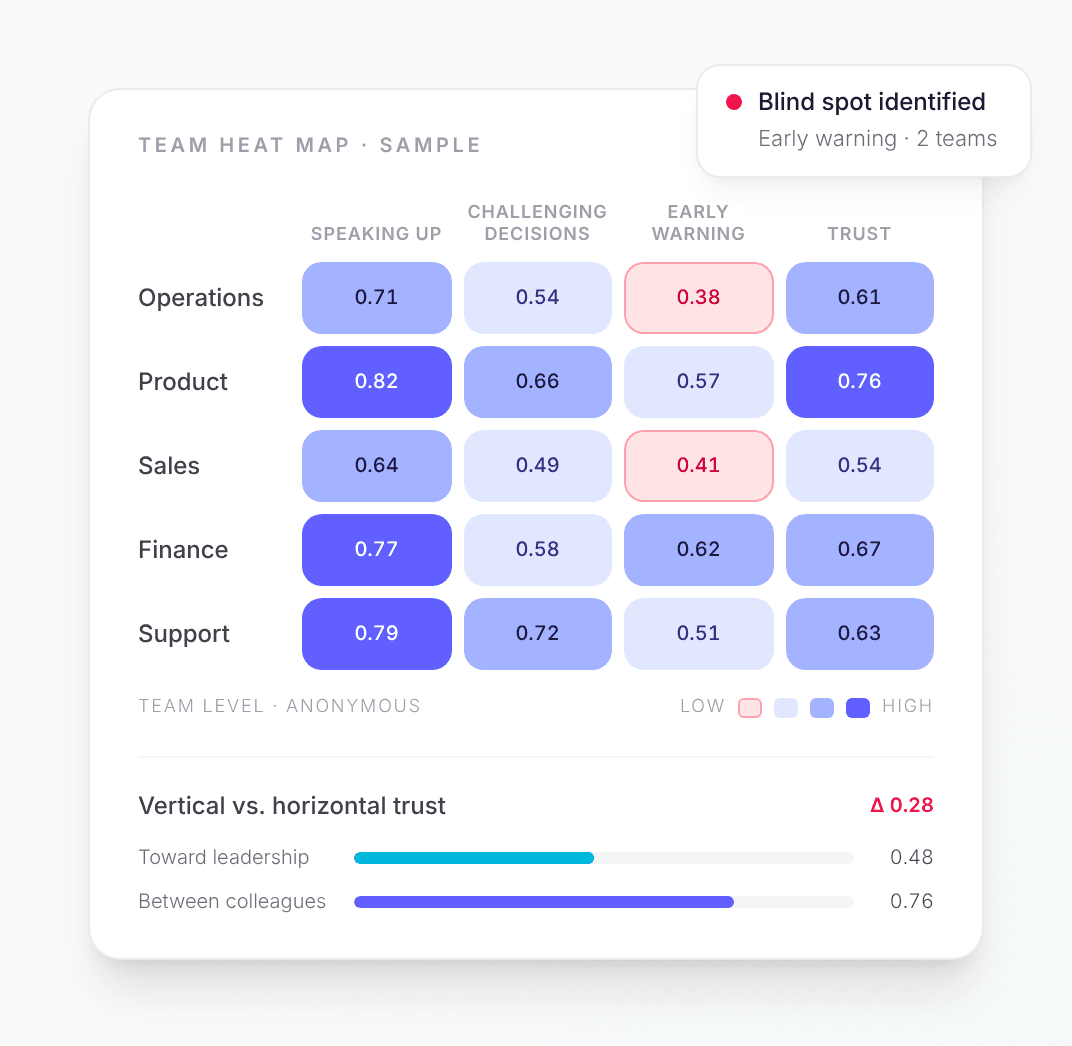
Each team's results on the four dimensions: speaking up, challenging decisions, early warning and trust.
Heat map
Where information gets stuck, across teams and leadership layers.
Vertical vs. horizontal trust
The gap between trust toward managers and leadership and trust between colleagues.
Organization-wide view
Shown only where aggregating the data is methodologically sound.
Three situations where Trust & Psychological Safety Index makes the difference
Problems keep surprising you.
Delays, client issues and failed initiatives reach leadership late, and afterwards it turns out that someone knew much earlier.
Meetings are quiet, decisions go unchallenged.
Proposals pass without objection, but execution stalls later. You are not sure whether that is agreement or silence.
You are going through change.
A reorganization, an integration or new leadership raises the stakes of speaking up. You want to know where information still flows and where it has stopped.
See how fast bad news reaches your leadership.
A 30-minute walkthrough using anonymized data from a similar-size organization. No commitment, no pre-work.
Book a demo